
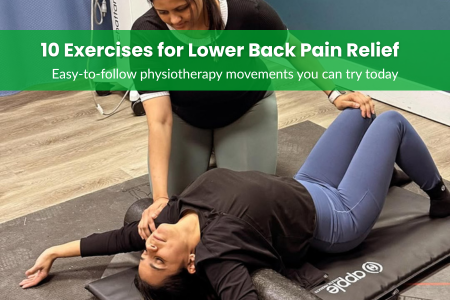
10 Physiotherapy Exercises to Relieve Lower Back Pain
Lower back pain is one of the most common issues we see at our Etobicoke clinic, and it touches people from virtually every walk of life. Desk workers, active parents, weekend athletes, trades workers — back pain doesn't play favourites. It can develop gradually from prolonged sitting or poor posture, or come on suddenly after a lift gone wrong or a sports injury.
The good news is that most lower back pain responds well to targeted movement. The key is choosing the right exercises and performing them correctly.
Here are 10 physiotherapy-recommended exercises for lower back pain relief. These are movements our team regularly incorporates into patient treatment plans, and most can be done at home without any equipment.
A few things to know before you start: These exercises are appropriate for general lower back discomfort. If your pain is severe, radiating into your leg, or the result of a recent injury, speak with a physiotherapist before starting a home program.
1. Cat-Cow Stretch
An excellent warm-up for any back routine. It gently mobilises the spine and is particularly useful for that first-thing-in-the-morning stiffness.
Start on hands and knees. Slowly round your back upward (cat), then gently lower it into an arch (cow). Move with your breath — exhale as you round, inhale as you arch. Repeat 8–10 times.
Common mistake: Moving too quickly. Let your breath set the pace — the slower, the better.
2. Child's Pose
A reliable decompression stretch for the lumbar spine and hips. Simple, but genuinely effective.
From kneeling, sit back toward your heels, extend both arms forward, and rest your forehead down. Hold 20–30 seconds. If your hips don't reach your heels, a folded towel underneath helps.
3. Pelvic Tilts
Often underestimated, pelvic tilts are a foundation of lower back rehab. They activate deep core muscles and help restore normal lumbar movement patterns.
Lie on your back with knees bent. Gently flatten your lower back against the floor by engaging your abdominals. Hold 5 seconds, release, and repeat 10–12 times.
Common mistake: Squeezing the glutes to create the tilt. The movement should come from your abdominals — a subtle distinction that makes a real difference.
4. Glute Bridges
Strong glutes reduce the load placed on the lumbar spine — which is why this is one of our most frequently prescribed exercises for back pain.
Lie on your back with knees bent and feet flat. Drive through your heels to lift your hips until your body forms a straight line from knees to shoulders. Lower with control. Aim for 12–15 repetitions.
Common mistake: Overextending at the top. If you're pushing past a straight line, you're likely loading your lower back rather than your glutes.
5. Knee-to-Chest Stretch
Particularly helpful after long periods of sitting, as it relieves compression in the lower lumbar joints.
Lie on your back and draw one knee gently toward your chest. Hold 20–30 seconds, then switch sides. You can bring both knees in at once for a broader stretch.
6. Bird Dog
A cornerstone of lower back rehabilitation. The bird dog trains core stability without placing compressive stress on the spine.
On hands and knees, slowly extend one arm forward and the opposite leg back. Hold 5–10 seconds, then switch sides. The most common mistake is letting the hips rotate — keep them level throughout.
7. Seated Spinal Twist
Restores rotational mobility and eases tightness through the mid and lower back.
Sit with one leg extended and the other bent across it. Rotate your torso gently toward the bent knee, using your arm lightly for support. Hold 15–20 seconds per side.
Common mistake: Rounding forward as you twist. Sit tall first — rotation should come from your thoracic spine, not your lower back.
8. Lying Lateral Leg Lifts
Hip abductor weakness is a surprisingly common contributor to lower back pain. Strengthening this area takes real pressure off the lumbar spine.
Lie on your side with your body aligned. Lift the top leg to roughly 45 degrees, pause briefly, then lower slowly. Perform 12–15 repetitions per side.
Common mistake: Rolling the hip backward to get more height. If you need to tip back to lift, reduce the range and focus on control instead.
9. Dead Bug
We favour this over traditional crunches for back pain patients. The dead bug builds deep core strength — specifically the transverse abdominis — without the lumbar flexion that crunches create.
Lie on your back with arms extended toward the ceiling and knees bent at 90 degrees. Slowly lower one arm overhead while extending the opposite leg, keeping your lower back pressed firmly to the floor. Alternate sides. Move deliberately — control is the whole point here.
10. Wall Sits
An underrated exercise for spinal support. Wall sits build endurance in the hips, quads, and core — all of which contribute to lower back stability.
Stand with your back flat against a wall, then slide down until your thighs are roughly parallel to the floor. Hold 20–30 seconds, gradually working toward longer holds as you get stronger.
These exercises work best when done consistently. For most people, five to six days a week produces better results than occasional intense sessions. If you're putting in the effort and still not seeing improvement after two to three weeks, that's worth paying attention to.
When Should You See a Physiotherapist for Back Pain?
These exercises can go a long way, but they're not always the complete answer. Consider booking an assessment if:
- Your pain has lasted more than two to three weeks without improvement
- Pain is radiating into your leg or foot, or causing numbness and tingling
- Your back pain followed a fall, accident, or significant strain
- Pain is disrupting your sleep or limiting basic daily tasks
- The same issue keeps returning, even after it seems to settle
Recurring or persistent lower back pain usually has an underlying cause that exercises alone won't fully resolve. A physiotherapy assessment identifies that cause and helps build a plan that actually addresses it — not just the symptoms.
Book Your Free Consultation at Waterfront Physio & Rehab
Our licensed physiotherapists in Etobicoke have helped hundreds of patients move past lower back pain — from residents in Mimico, Long Branch, and Alderwood to those along The Queensway and throughout South Etobicoke. We take the time to understand what's actually driving your pain and build a personalized treatment plan around it.
We offer direct billing to most major insurance providers, and our clinic has earned 300+ five-star Google reviews from patients across the community.
Call us at 416-252-4855 or book your free consultation online today. Let's get you back to moving well.